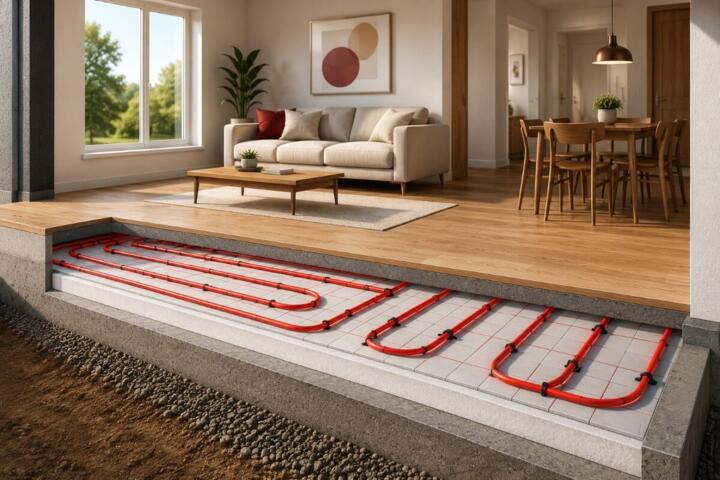
Insulation And Heat Pumps
Energy renovation ROI depends on how much heat your home loses and how efficiently you replace that heat. Insulation reduces heat loss through walls, roof, floors, and air leakage, which lowers the heating load. A heat pump then supplies heat to that reduced load using electricity, with efficiency measured by seasonal performance rather than a single lab rating.
In practice, many households see the biggest bill drop when they pair air sealing and insulation with correct heat pump sizing. A heat pump installed into a leaky, poorly insulated house often runs longer, cycles more, and may struggle during cold snaps. A well-insulated envelope can also reduce the need for backup heat, which changes both operating cost and comfort during defrost cycles.
For a concrete example, a typical retrofit plan might start with attic insulation and sealing around plumbing penetrations, then move to duct sealing or hydronic distribution checks, and only then size the heat pump. The order matters because insulation changes the target heating load that determines equipment capacity and controls.
Common ROI Pain Points
People often treat insulation and heat pumps as interchangeable upgrades, but they act on different parts of the system. Insulation changes demand; a heat pump changes supply. If you compare costs without separating those roles, you can misread payback.
One frequent mistake is using “nameplate” efficiency numbers instead of seasonal performance. Heat pumps are rated with metrics such as HSPF (in some markets) or SCOP/SEER (in EU contexts), and real-world performance depends on outdoor temperature, indoor setpoints, distribution losses, and defrost behavior. A contractor quote that ignores your home’s heating load and duct or pipe losses can produce a misleading ROI estimate.
Another pain point is ignoring air leakage. In many retrofit audits, blower-door results show that uncontrolled infiltration can dominate heat loss even when insulation looks adequate. If you add insulation but leave gaps around windows, rim joists, or service entries, the heat pump still has to cover that leakage load.
Electricity price risk also gets overlooked. Heat pumps shift energy from gas or oil to electricity, so ROI depends on your tariff, time-of-use rates, and whether you can schedule defrost-heavy operation or domestic hot water within your utility constraints. In some regions, incentives reduce purchase cost but do not change operating cost, so the payback timeline can stretch if electricity prices rise.
Finally, supporting technologies can make or break performance. Thermostatic radiator valves, mixing valves, weather compensation controls, and domestic hot water strategies all affect runtime and comfort. A heat pump that is technically “efficient” can still underperform if the control strategy fights the building’s thermal mass—an issue that shows up as short cycling and uneven temperatures.
How To Plan A 2026 ROI
Start With A Heat Loss Audit
Use an audit that estimates heating load in kW at a defined outdoor design temperature, not just a generic “energy score.” In the US, a Manual J-style calculation or an equivalent method can provide a baseline, while in EU contexts you may see building energy assessments aligned with EPBD frameworks. Ask for the assumptions: indoor setpoint, ventilation rate, insulation levels, and infiltration method.
Then measure what you can verify. A blower-door test for air leakage and a thermal inspection (often with infrared imaging) can identify bypass paths. If you’re doing this in phases, record pre-retrofit temperatures and fuel use for at least one heating season; I’ve seen homeowners skip the baseline and later argue about whether the upgrade “worked,” which is avoidable with a simple meter log.
Realistic outcome: insulation and air sealing typically reduce heating demand before any equipment purchase. The magnitude varies widely by building age and leakage, but even modest reductions can change the heat pump size class and backup needs.
Insulation First, Then Sizing
Sequence upgrades so the heat pump targets a reduced load. Common starting points include attic/roof insulation, floor insulation over unheated spaces, wall cavity or exterior insulation where feasible, and air sealing at penetrations. If ducts or pipes are in unconditioned spaces, sealing and insulating them can act like “hidden insulation” for the distribution system.
After envelope work, re-check the heating load and distribution losses. Heat pump sizing should reflect the distribution type: forced-air ducts with leakage behave differently from well-insulated hydronic loops. Controls also matter; weather-compensated curves can reduce overshoot and cycling, while poorly set curves can increase runtime.
Realistic outcome: many homeowners find that insulation reduces the required capacity, which can lower both capital cost and operating cost. The exact payback depends on local energy prices and incentive rules, which vary by country and sometimes by utility territory.
Model Operating Cost With Your Tariff
Use your actual electricity and fuel rates, including delivery charges and any time-of-use structure. Heat pumps convert electricity to heat with a seasonal efficiency that changes with outdoor temperature and system design. If your utility offers a winter peak rate, the same heat pump can cost more even when it runs efficiently.
Ask for a seasonal performance estimate tied to your climate and system type. In EU markets, look for SCOP values and the test conditions they correspond to; in other markets, ask for HSPF or equivalent seasonal metrics. If the quote only lists a single COP at one temperature, treat that as incomplete for ROI.
Realistic outcome: you can often bound ROI by running two scenarios—one with conservative seasonal efficiency and one with optimistic but still plausible performance. I’ve used a spreadsheet approach with a “winter average” efficiency assumption and a separate “cold snap” assumption, because defrost and backup behavior can swing costs.
Track Results With Metering
Plan measurement before you start. For insulation-only phases, track gas or oil consumption and indoor temperatures. For heat pump phases, track electricity use and, if possible, heat output proxies such as flow temperature and runtime from the unit’s monitoring interface.
Many heat pumps provide internal logs; a homeowner might export data from an app or service portal. If you’re using a tool like Home Assistant, version matters for integrations—one setup I saw used a 2024.12 build and then broke after a firmware update, which is why you should also capture screenshots or CSV exports during the first month.
Realistic outcome: measurement reduces uncertainty in ROI. It also helps you detect problems like short cycling, insufficient airflow across indoor coils, or a backup heater that triggers too often.
Educational Case Examples
Row House With Attic Upgrade
A family in a mid-terrace row house (built mid-20th century) had high winter drafts and uneven bedroom temperatures. They added attic insulation and sealed air leaks around service penetrations and the attic hatch. Their baseline fuel use was logged for one winter, then compared to the next winter after the envelope work.
Their heating demand dropped enough that the existing boiler ran fewer hours, and indoor temperatures stabilized without raising setpoints. They delayed heat pump installation until after the next audit because the first phase already changed comfort and reduced the load estimate. The lesson: insulation ROI can be measured directly through fuel consumption before committing to a new heating system.
Detached Home With Heat Pump Sizing
A detached home with older windows and a partially insulated basement received a heat pump quote based on floor area alone. After an audit, the contractor revised the heating load estimate and recommended additional air sealing and basement insulation before final sizing. The heat pump was then selected with a capacity closer to the revised load, and the control curve was tuned to reduce cycling.
During the first cold weeks, the homeowner monitored electricity use and indoor temperatures. The backup heater triggered less often than in the initial plan, and comfort improved in rooms far from the thermostat. The lesson: sizing and controls depend on the envelope, and a mismatch can show up as higher electricity use and more frequent backup operation.
Insulation Vs Heat Pump Checklist
| Decision Factor | Insulation Focus | Heat Pump Focus | What To Check In Quotes |
|---|---|---|---|
| Primary effect | Reduces heat loss (demand) | Supplies heat efficiently (supply) | Load calculation vs “rules of thumb” |
| Key dependency | Air sealing and thermal bridges | Seasonal efficiency and controls | Blower-door results and SCOP/seasonal metrics |
| ROI sensitivity | Fuel price and comfort gains | Electricity tariff and cold-weather behavior | Tariff assumptions and backup heater logic |
| Best measurement | Fuel use before/after | Electricity use and runtime logs | Metering plan and baseline season |
| Common failure mode | Air leakage left untreated | Oversizing, short cycling, wrong curves | Missing blower-door and missing load revision |
Step-by-step checklist for decision support:
- Collect one heating season of baseline fuel and indoor temperature data.
- Run a heat loss audit that includes infiltration and distribution losses.
- Quote insulation with a plan for air sealing and thermal bridge treatment.
- After envelope work, re-check the heating load and revise heat pump capacity.
- Model operating cost using your electricity tariff and a seasonal efficiency metric.
- Plan metering so you can compare before/after with the same thermostat strategy.
Common Mistakes To Avoid
One mistake is buying a heat pump before sealing major air leaks. The system may still heat the home, but electricity use can rise and backup heaters can trigger more often, which makes ROI estimates drift.
Another mistake is treating insulation thickness as the only variable. Thermal bridging at slab edges, rim joists, and window reveals can reduce the effective benefit. If the quote does not mention bridge mitigation or air sealing, the ROI calculation rests on assumptions that often fail in real buildings.
People also confuse “comfort” with “efficiency.” A higher setpoint can mask poor performance by raising demand. If you compare bills, keep setpoints and ventilation habits consistent across seasons, or normalize using degree days and measured fuel use.
Finally, homeowners sometimes accept a single payback number without a range. Electricity tariffs, cold snaps, and seasonal efficiency swings can shift results by months. A quote that refuses to discuss assumptions—like how backup heat is controlled—should raise skepticism.
FAQ
Which Upgrade Cuts Bills Faster?
Insulation and air sealing often reduce heating demand immediately, so fuel use can drop in the first winter after the envelope work. Heat pump savings depend on installation timing, correct sizing, and seasonal efficiency under your climate and tariff.
How Do I Compare ROI Without Guesswork?
Use a baseline heating season, then compare measured fuel or electricity use after the upgrade. Pair that with an audit-based heating load estimate so the heat pump size and expected seasonal performance match your building.
What Happens If The Heat Pump Is Oversized?
Oversizing can increase cycling, reduce effective seasonal efficiency, and create uneven temperatures. It can also raise the chance that controls trigger backup heat during transitions, depending on the system design.
Do Incentives Change Payback Timing?
Incentives usually reduce upfront cost, which shortens payback if operating costs stay similar. They rarely change seasonal efficiency, so long-term ROI still depends on electricity prices and how the system performs in cold weather.
Can I Measure Success In One Season?
One season can show directionally correct results if weather conditions are similar and you track the same thermostat strategy. For stronger confidence, compare at least two heating seasons or normalize using degree days and metered energy.
Author's Insight
Energy ROI comparisons work best when you separate demand reduction from supply efficiency. Insulation and air sealing reduce the heating load that determines heat pump capacity and control behavior. Heat pump ROI then depends on seasonal performance, distribution losses, backup heater logic, and your electricity tariff structure.
Because incentives and energy prices vary by location, the most reliable approach uses your own baseline consumption and a load-based sizing estimate. Measurement after installation matters as much as the initial quote, since short cycling and backup triggers often show up in the first weeks.
Key Takeaways
- Insulation targets heat loss; heat pumps target heat delivery efficiency, so ROI math must treat both roles.
- Air sealing and distribution losses can dominate results, and they affect heat pump sizing.
- Use seasonal efficiency metrics and your real electricity tariff, not a single COP number.
- Plan metering and compare before/after with consistent thermostat settings to reduce uncertainty.